Fence installation step by step
Installing a fence looks simple: holes, posts, infill. But the order and the time between the steps decide whether the fence still stands straight in five years.
1. Setting out
First it has to be clear where the fence will run. On site the line is marked with string between the end points and the post positions are measured off it. If the boundary is uncertain or disputed, a surveyor belongs here, before any material is ordered. Moving a string costs nothing; moving concreted posts does not.
2. Post spacing
Spacing is not set by eye. It follows from the size of the infill, the height of the fence and how much wind pushes against it. A solid fence needs posts closer together than open boards of the same height, because it behaves like a sail. Corners, bends and the positions beside gates have their own rules and often a different post diameter.
3. Holes and concreting
Holes are dug by hand, with an auger or with a powered earth auger, depending on the ground. The post is set, plumbed and concreted in. The alternatives are base plates bolted to existing concrete or paving and, in some cases, ground screws that are driven in without any wet work.
On rocky ground and in waterlogged clay the method changes, each in its own way. That is why this is decided during the survey on site rather than from a photo.
4. The wait that cannot be skipped
The concrete has to cure before the infill is hung on the posts. That means days, not hours. This is why fence installation is split into two visits on most jobs, and why the schedule cannot be shortened by sending more people. If someone promises a finished fence in one day including concreted posts, ask how they handle this.
5. The infill
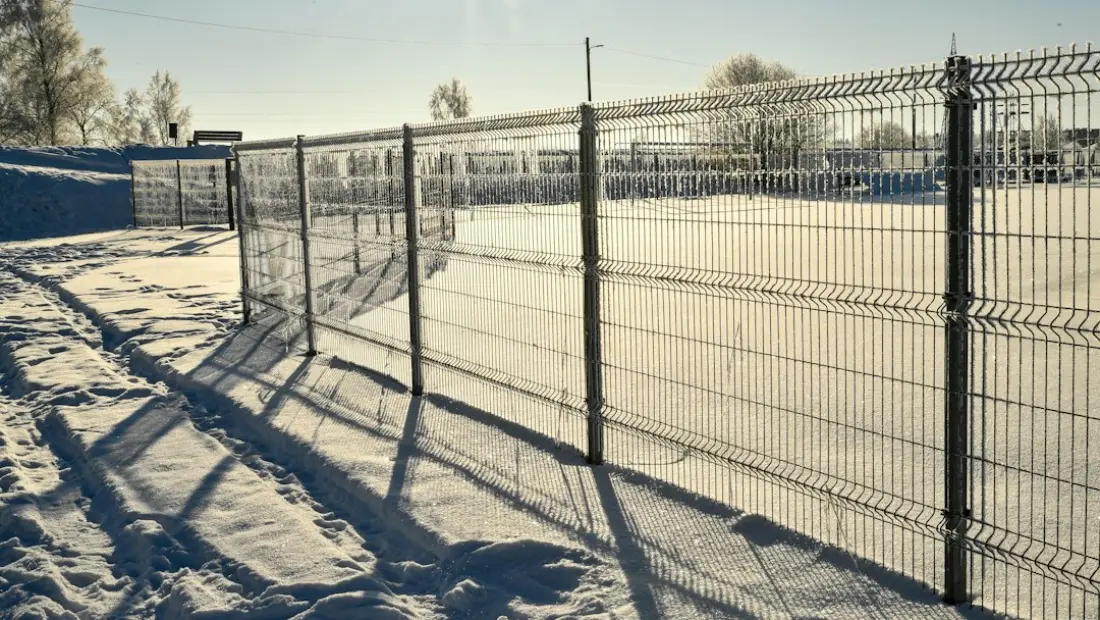
Panels, mesh or wooden bays go onto the cured posts. With mesh, a tension wire is threaded through the eyes and the mesh is stretched between braced posts. With panels, clips are fitted. With timber, the horizontal rails are fixed first and the boards only after that.
6. Finishing at ground level and the gates
Either ground boards are fitted, or the gap at the bottom is levelled with soil. Then come the wicket and driveway gates, which are adjusted last because they are aligned against the finished fence. If a gate is to be powered, the electricity supply and the conduit must already be in place, laid long before the posts were concreted. See wicket gates and driveway gates.
What changes on a slope
Mesh follows the slope smoothly. Panels, wooden bays and concrete units are stepped, and every step means another post and another hole. That is why the slope of the plot belongs in the enquiry at the very start, not only at the survey.