Metal fence, mesh and 3D panels
Metal is the usual choice where the fence has to last and must not eat up your time. What differs is mainly the infill: mesh, a welded panel or a metal unit.
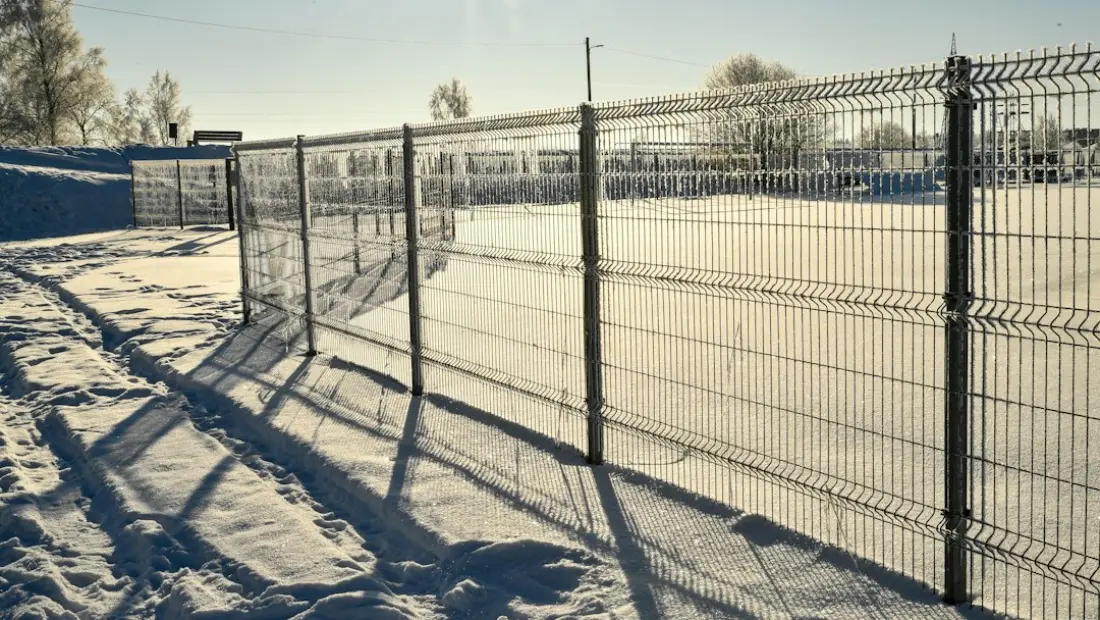
A turnkey metal fence covers three different things: square or welded mesh, welded 2D and 3D panels, and metal fence units. They share the posts and the fixings and differ in looks, in how demanding the installation is and in how they cope with uneven ground.
Plastic-coated mesh
Mesh is the cheapest in material and the most demanding to tension properly. The plastic coating protects the wire and extends its life compared with galvanising alone. The mesh is tensioned on a wire threaded through the eyes and fixed to posts, which are braced at corners and beside gates. Its biggest advantage: on a slope it follows the ground smoothly and does not have to be stepped.
Welded 2D and 3D panels
A 3D panel has pressed ribs that stiffen it, so at the same height it bends less than a flat 2D panel. It is fitted into clips on the posts, usually with a ground board at the bottom. It looks tidier than mesh and goes up faster, but on a slope it has to be stepped panel by panel.
Metal fence units and infills
Where the fence has to look representative, metal units with horizontal or vertical slats are used. They can be made semi-open or solid and match a gate in the same design. An anthracite shade close to RAL 7016 is the most common choice here, because it does not disappear against either greenery or a facade.
What a metal fence needs on top
Posts, base plates or concreting, ground boards, clips and, with mesh, tensioners. It is an inconspicuous part of the budget that adds up over a longer boundary. If you are planning a powered gate, the electricity supply and a conduit are dealt with before the posts are concreted in. There is more in the section on wicket gates and driveway gates.
What to tell us
- The length of the boundary in metres and the number of corners
- The height of the fence
- Whether you want mesh, a panel or a metal unit
- Ground boards, yes or no
- The slope of the plot
- The number of gates and whether a gate should be powered
- What stands on the boundary today
Combining materials on different sides of a plot is common and often the cheapest route. How that is done is described on the page about turnkey fencing of a whole plot. If you are after a solid option, have a look at the wooden fence with a solid infill.
Frequently asked questions
Mesh or a 3D panel?
Mesh is cheaper in material, copes with a slope without stepping and suits longer boundaries and animal runs. A 3D panel looks tidier, holds its shape without a tension wire and goes up faster, but on a slope it has to be stepped panel by panel. On the street side a panel is the usual choice, on the back boundary mesh.
Do I need ground boards?
They are not compulsory. They close the gap at ground level that would otherwise have to be filled by levelling, and they keep the bottom edge of the fence straight. They make sense where nothing should pass under the fence. Without them the fence is cheaper and installation is quicker.
How are the posts anchored?
Either concreted into a dug hole, or on a base plate bolted to existing concrete or paving. Concreted posts need time to cure, which is why installation is usually split into two visits. On rock and in waterlogged ground the method differs, and that is decided by the survey on site.
Tell us the length of your fence
An approximate length, the height you want and whether the plot slopes is enough to start. We will fill in the rest.
We pass the enquiry to a fencing company that works in your area. If we have no partner there, we will tell you straight away instead of leaving you waiting.
Phone: 775 654 443
E-mail: [email protected]